
The most valuable skill founders can develop today is not management — it is the ability to think in systems.
I recently watched Ali Alqaraghuli’s “Engineering is the new MBA” (watch here: https://lnkd.in/dn7rweTY), and my immediate reaction was simple:
If the Indian education system allowed students to truly experience the depth and beauty of engineering thinking, we would likely see far more founders capable of building companies at the scale of Musk or Altman.
At the heart of every great company lies not just a successful product, but the way that product evolves — how quickly it adapts, reacts, and improves.
The best founders don’t just build products.
They build systems that learn.
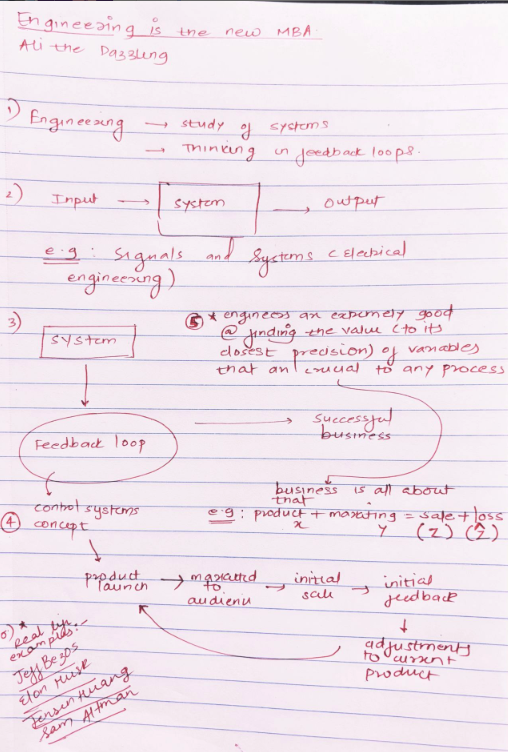
This is the essence of engineering thinking — not merely solving problems, but designing feedback loops that continuously refine solutions. In control systems, a foundational concept in electrical engineering, systems evolve through structured feedback. The same principle applies directly to startups.
In practice, every startup operates as a loop:
Launch → Learn → Iterate → Scale
This mirrors the engineering framework:
Input → System → Output → Feedback → Adjustment
This is not abstract theory. It is how some of the most influential founders operate.
It is perhaps no coincidence that many of the world’s most consequential companies emerged not from financial centers, but from ecosystems built around engineering culture.
But what if you don’t come from an engineering background?
You do not need an engineering degree to think like an engineer. What you need is clarity, curiosity, and the discipline to model systems.
Start by observing your work — or your startup — as a machine:
- What are the inputs? (time, capital, energy)
- What are the outputs? (revenue, impact, retention)
- What feedback loops exist? (customer response, churn, engagement)
If you spend most of your time building, allocate a portion of it to learning from those who have built before you. Study their thinking, their frameworks, and the principles they relied on. Building a company is not merely a commercial exercise — it is a deeply philosophical one.
One practical way to internalise this mindset is to start documenting your decisions. Treat them as you would debugging code:
- Where did the logic fail?
- What could be optimised?
- What feedback did you ignore?
The objective is not perfection — it is iteration.
Over time, you begin to see complexity not as chaos, but as structure. And iteration not as repetition, but as power.
Finally, approach every input — whether time, capital, or effort — with intention. Maintain a mental ledger of outcomes, and use those outcomes as feedback for your next decisions.
That is how systems improve.
And that is how companies are built.

